
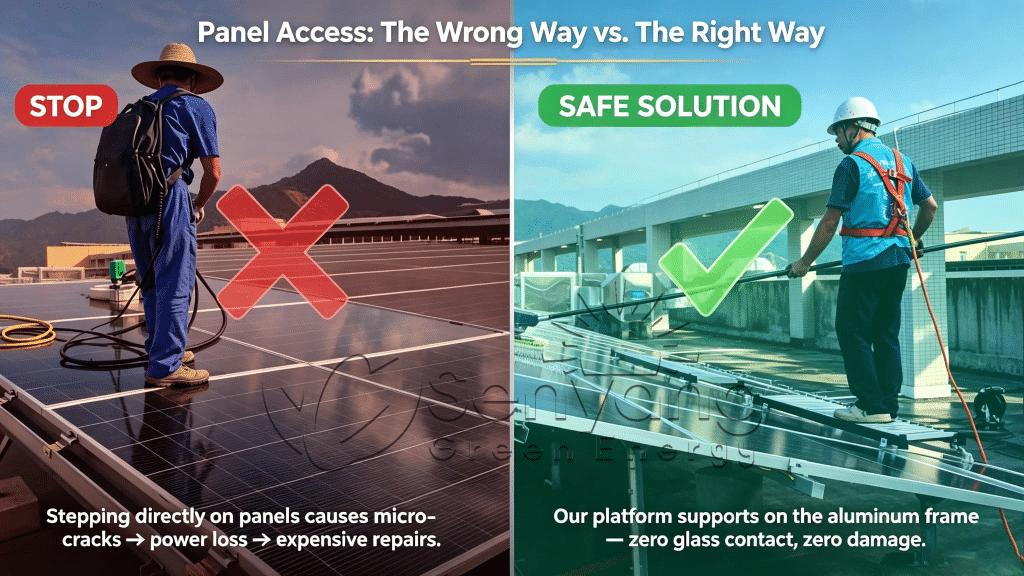
When designing a solar power plant, engineers obsess over wind loads, inverter efficiency, and module degradation rates. But there is a silent, catastrophic risk that rarely makes it into the financial model: the human footstep.
In the daily O&M (Operations & Maintenance) of a solar plant, technicians must often access inner rows to clean dust, inspect junction boxes, or troubleshoot cables. Without a dedicated access solution, the easiest path is often to simply step on the modules.
It looks harmless. The glass doesn’t shatter. The technician finishes the job. But beneath the surface, a chain reaction has just begun.
Here is the science behind why stepping on a solar panel is one of the most expensive mistakes in the industry—and why the Senyang Portable Aluminum PV Maintenance Platform is the ultimate insurance policy for your asset.
The Science: Why Solar Glass Hates “Point Loads”
To understand the danger, we must look at how solar modules are built.
A standard PV module is a sandwich of solar cells, encapsulant (EVA), backsheet, and tempered glass, all bound by an aluminum frame. This structure is incredibly strong. It is designed to withstand uniform distributed loads—like a heavy blanket of snow or high wind pressure pushing evenly across the entire surface.
However, human weight is entirely different. When a technician steps on a panel, the impact is not distributed. It is concentrated into a tiny area—the size of a boot heel. This is called a Point Load.
Under a point load, the glass bends microscopically. Because the silicon solar cells inside are crystalline and brittle, they cannot flex. They crack.
The Invisible Threat: Micro-Cracks and Hot Spots
These fractures are usually invisible to the naked eye. They are called micro-cracks.
At first, a micro-crack seems harmless. But as the plant operates, the modules undergo daily thermal expansion and contraction (heating up in the sun, cooling at night). The micro-crack slowly widens.
Eventually, it severs the electrical path of a solar cell. This creates a Hot Spot. The cell stops generating power and instead acts as a resistor, heating up to extreme temperatures. This can melt the backsheet, damage the glass, and even cause a fire hazard.
What started as a simple cleaning job has now permanently degraded the module’s output.
The Financial Trap: The Warranty Denial
This is where the real financial pain hits.
When a module fails, the asset owner files a warranty claim. The manufacturer sends an inspector. They use Electroluminescence (EL) imaging to look inside the module. They find the micro-cracks.
The inspector looks at the crack pattern. It is not a uniform stress fracture from snow. It is a localized, spider-web pattern originating exactly where a boot stepped on the glass.
The manufacturer’s verdict? “Mechanical damage due to foot traffic.”
The warranty is denied. You are now forced to pay for the replacement module, the high-altitude labor to swap it out, and you have lost the power generation during the downtime.
The Senyang Solution: Zero Glass Contact, Zero Damage
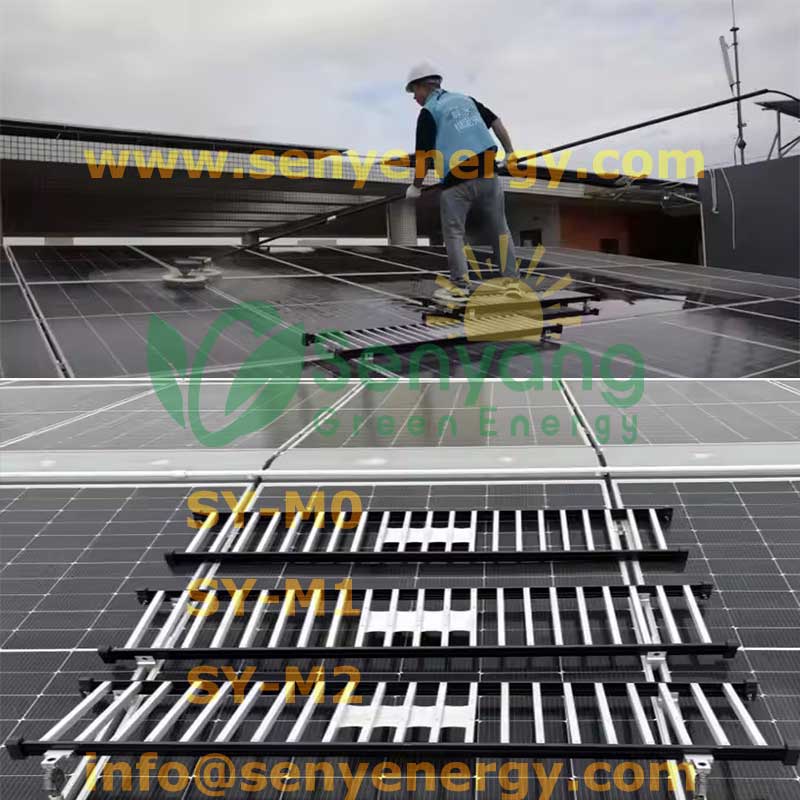
How do you clean the middle of a massive array without stepping on the glass?
You stand on the frame instead.
En Senyang Portable Aluminum PV Maintenance Platform is engineered to completely eliminate the risk of micro-cracks. It is built on a fundamental principle: Zero Glass Contact.
- Smart Structural Support: The platform’s support legs are not flat plates resting on the glass. They are precision-designed to lock securely onto the strongest part of the module—the aluminum frame—or to rest firmly in the structural gaps between adjacent panels.
- Weight Transfer: By anchoring to the frame, the weight of the technician and their tools is transferred directly into the mounting structure, completely bypassing the fragile glass.
- Anti-Slip & Protective: The support feet feature specialized EPDM rubber pads. These protect the aluminum frame from scratches and ensure the platform stays rock-solid, even when the panels are wet and slippery during cleaning.
Built for the Modern O&M Crew
We know that O&M teams are under pressure to work fast. A safety platform is only useful if it doesn’t slow the crew down. That’s why we designed the Senyang platform with three key features:
- One-Hand Operation: Made from high-strength, lightweight aluminum, it can be carried and deployed with a single hand. The other hand is free for safety harnesses, water hoses, or testing equipment.
- Modular Splicable Design: Every array is different. Our platform comes in 3 full series models that can be connected together. You can quickly build a custom-length walkway to span across multiple rows, maximizing cleaning efficiency.
- Crack-Proof Confidence: Technicians can focus entirely on the quality of their cleaning or inspection, rather than worrying about where they are stepping.
The Bottom Line
A solar plant is a 25-year asset. The difference between a highly profitable project and a financial disaster often comes down to the details you can’t see.
Don’t let a simple cleaning task compromise your modules. Protect your glass. Protect your warranty.
Invest in the Senyang Portable Aluminum PV Maintenance Platform—the smart, safe, and cost-effective way to keep your solar asset performing at its peak.
📩 Ready to upgrade your O&M safety? Contact us today to learn more about our 3 models and modular configurations.
📞 Whatsapp+86 14700065579
#SolarMaintenance, #solarpanelcleaning #SolarO&M #SolarInstallation #PVHardware #SolarSafety#solarPV #PVPowerStationConstruction #solarDailyMaintenance #PVDailyMaintenance
 English
 Bulgarian
 German
 Spanish
 Portuguese
 French
 Russian
 Indonesian